On October 9, a date celebrated in Brazil as Athletics Day, it is worth looking beyond the stopwatch and the medal table.
Athletics brings together some of sport's most essential movements: running, race walking, jumping, throwing and putting. Yet none of these gestures exists on its own. Behind every mark are repetition, teamwork, technique, adaptation, frustration, recovery and choice.
That is why every event holds an energy of its own — and every athlete builds a story that cannot be reduced to the final result.
João do Pulo: one jump, three visual narratives
On 15 October 1975, at the Pan American Games in Mexico City, João Carlos de Oliveira reached 17.89 m in the triple jump. He improved the previous world record by 45 centimetres, and his mark stood for ten years. João later won two Olympic bronze medals, in Montreal 1976 and Moscow 1980.
A single piece of source media can reveal different energies without changing the event that inspired it. Here, João’s jump becomes three Energy Cards — science fiction, surrealism and pixel art — each a visual interpretation of the same historic moment.
1. Quantum Leap Beyond the Horizon — science fiction
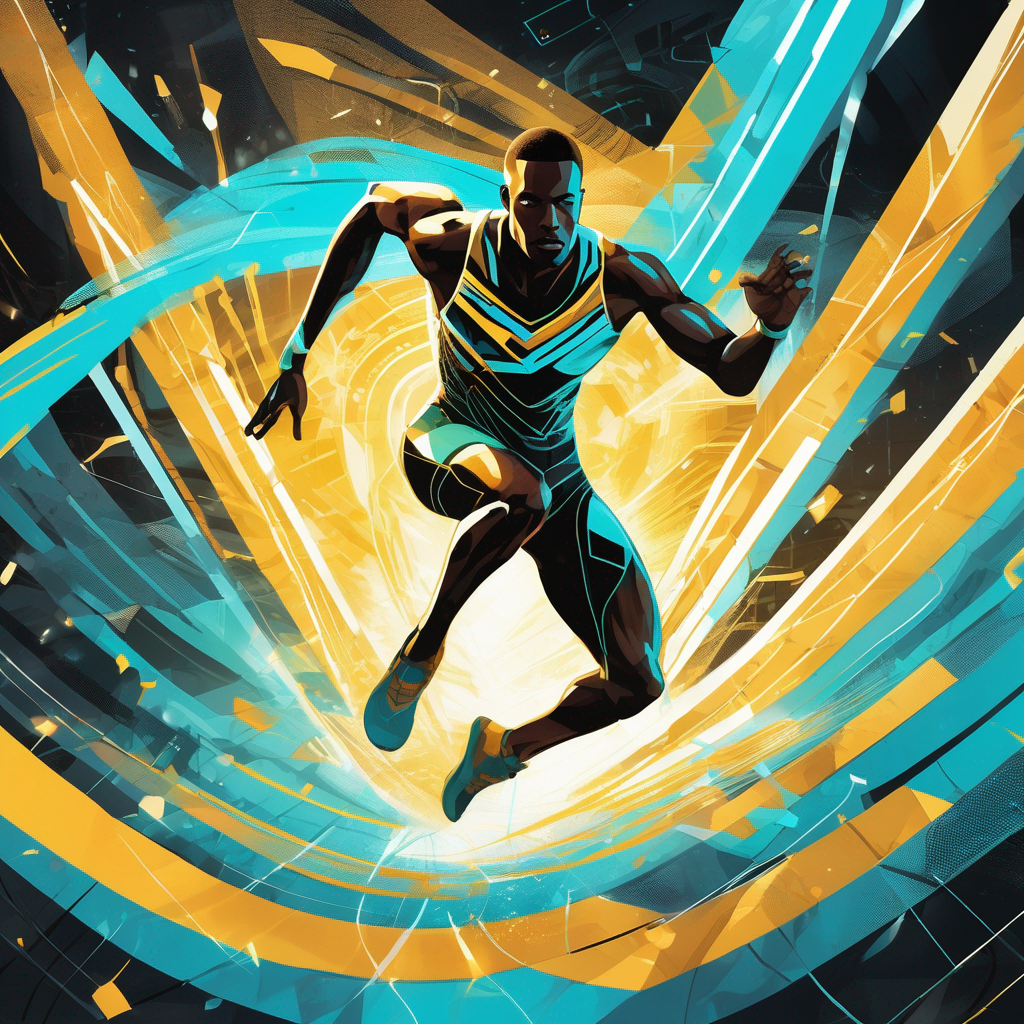
Momentum and acceleration become lines of energy, future and power. Open the science-fiction Energy Card.
2. Leap Without Borders — surrealism
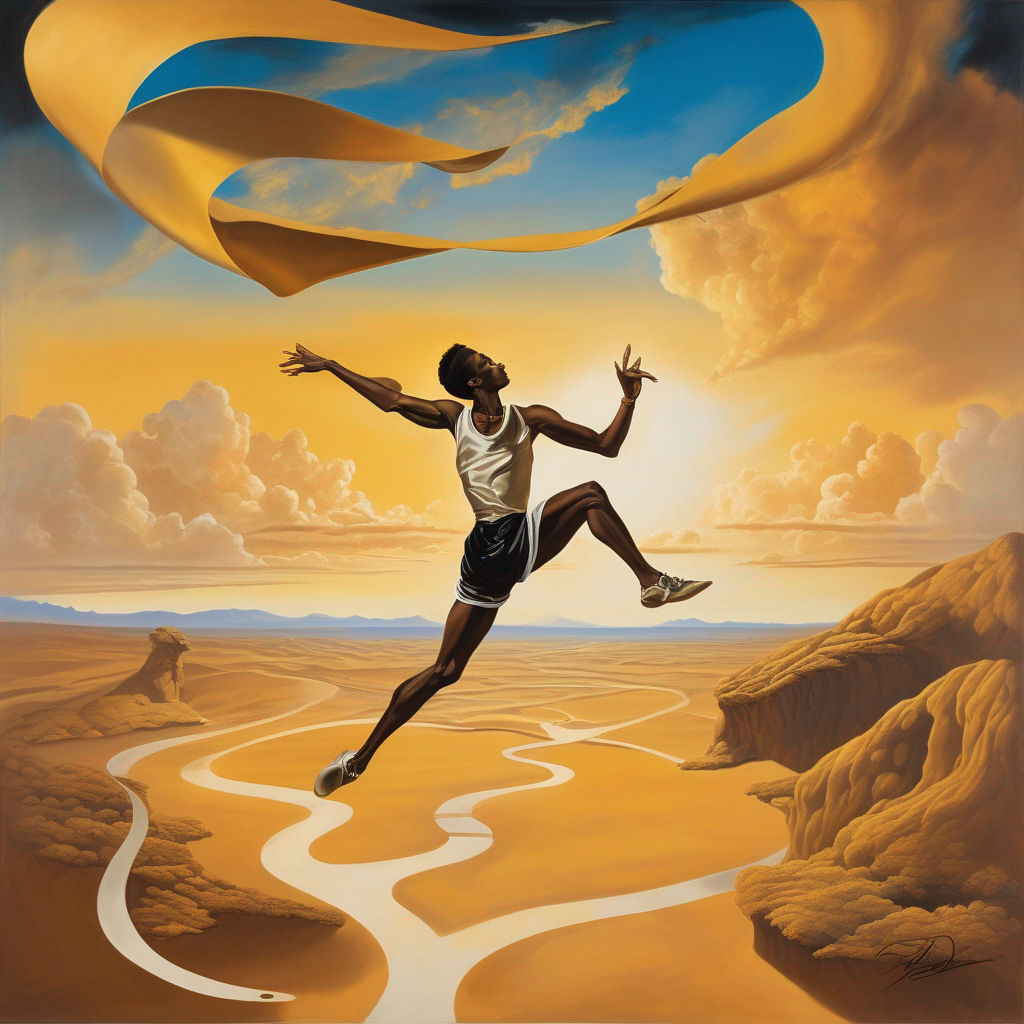
The landscape unfolds into winding paths and suspended ribbons, as though João’s flight were still crossing territories and generations. Open the surrealist Energy Card.
3. Flight Without Limits — pixel art
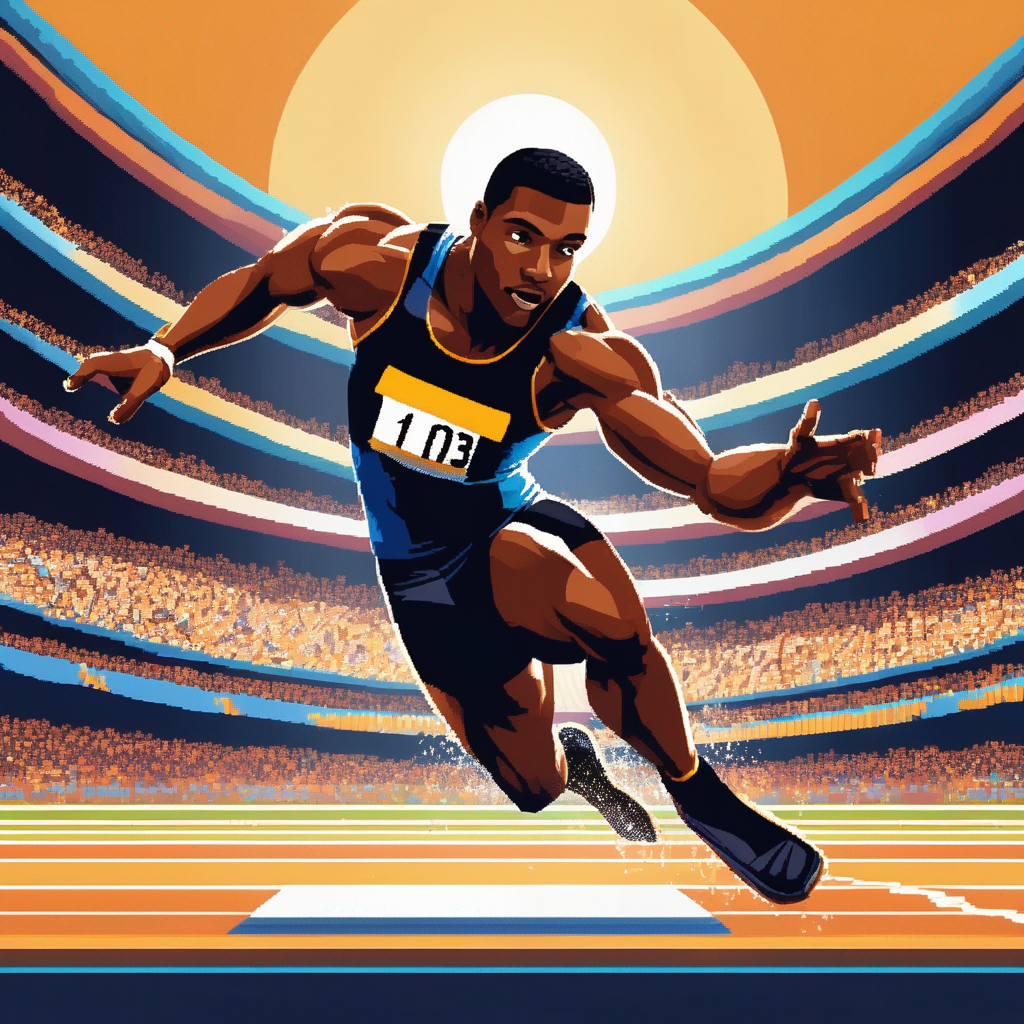
The stadium takes on the vibrant language of pixels to celebrate the instant when technique, speed and strength challenged gravity. Open the pixel-art Energy Card.
These are not three different jumps. They are three readings of the same media. An Energy Card works at the level of narrative and memory; it neither changes nor authenticates the historical event.
▶ Watch the historic 17.89 m jump on YouTube — external channel. Availability and rights to the video remain with the respective rights holders and the platform.
Thank you, João, for turning technique, power and courage into a horizon — and for leaving Brazilian athletics a jump that still crosses generations.
Read more in the Brazilian Olympic Committee special and the World Athletics heritage feature.
Athletics is not a single gesture
In sprinting, everything seems to happen at once. The start, acceleration and finish compress years of preparation into a few seconds.
In the hurdles, running also means reading distances, finding rhythm and reorganizing the body at every obstacle.
In middle- and long-distance events, the race is a continuous negotiation between strategy, endurance and time. In race walking, technical precision and consistency turn every step into a decision.
In the jumps, the run meets a moment of suspension. In the throwing events, strength, coordination and trajectory converge in a gesture that ends far beyond the hands.
Para athletics expands this language even further. Sport classes organize competition among athletes with comparable functional impacts, while prostheses, racing wheelchairs and other resources may be part of performance. In events for athletes with visual impairments, the relationship between athlete and guide is also part of the technique, trust and story built on the track.
There is no single way to experience athletics. There is a collection of movements, bodies, technologies, relationships and ways of overcoming sporting limits.
Brazil running, walking, jumping and throwing
Brazilian athletics is shaped by generations that opened paths and by athletes who continue to expand that story.
In the jumps, Adhemar Ferreira da Silva, a two-time Olympic triple jump champion, and Maurren Maggi, Olympic long jump champion, remain essential references. Fabiana Murer, world champion in the pole vault, strengthened Brazil's presence among the international elite. At Paris 2024, Valdileia Martins advanced to the high jump final after equalling the Brazilian record.
On the track, Joaquim Cruz made history in the 800 metres, while Alison dos Santos established Brazil among the leading nations in the 400-metre hurdles. Alison won his second Olympic medal at Paris 2024 and returned to the world podium at Tokyo 2025.
In race walking, Caio Bonfim won Olympic silver in the 20 km at Paris 2024. At the 2025 World Championships in Tokyo, he became 20 km champion and 35 km silver medallist — the best individual campaign by a Brazilian in the history of the outdoor World Championships. Viviane Lyra is another important presence in Brazilian race walking and joined Caio in the mixed relay in Paris.
In the throws, Luiz Maurício da Silva reached the Olympic javelin final in Paris with Brazilian and South American records. In the marathon, Vanderlei Cordeiro de Lima remains associated not only with a medal, but with one of Brazil's most widely recognised stories of sporting perseverance.
These names do not form a definitive ranking. They help show how many languages can coexist within a single sport.
The strength of Brazilian para athletics
Athletics is the sport that has earned Brazil the most medals in the history of the Paralympic Games. At Paris 2024, the Brazilian team won 36 athletics medals: ten gold, 11 silver and 15 bronze.
In 2025, Brazil topped the medal table at a Para Athletics World Championships for the first time. In New Delhi, the team won 44 medals — 15 gold, 20 silver and nine bronze.
In sprinting, Petrúcio Ferreira has built a dominant career in the men's 100 metres T47. Jerusa Geber, alongside her guide runners, won the women's 100 and 200 metres T11 at Paris 2024. Ricardo Mendonça became Paralympic champion in the men's 100 metres T37 and won both the 100 and 200 metres at the 2025 World Championships.
Rayane Soares won the women's 400 metres T13 in Paris with a world record. Thalita Simplício became a four-time world champion in the women's 400 metres T11 in New Delhi. In the longer distances, Yeltsin Jacques has achievements in the 1,500 and 5,000 metres T11, while Antônia Keyla became world champion in the women's 1,500 metres T20 in 2025.
In the field events, Claudiney Batista and Beth Gomes are among Brazil's leading discus throwers. Wanna Brito became world champion in the women's shot put F32 with a world record in New Delhi. Thiago Paulino remains a consistent presence among the leading names in the men's shot put and discus throw F57.
Each class has its own rules and criteria. Results from different classes should not be used to create simplistic comparisons. What connects these journeys is sporting excellence — not an attempt to erase their particularities.
Where does an Energy Card fit into this story?
A medal records a placing. A result sheet records a mark. A photograph records a frame.
A journey, however, needs context.
PicFlow Energy Cards turn authorised photos, videos or audio into visual pieces with a title, narrative and artistic interpretation. Gathered into albums, they can organise chapters that would otherwise remain scattered across phones, social networks and personal archives.
For an athlete, a collection can grow from different moments:
1. Origin
The first track, the school, the community project, the person who introduced the sport, or the place where movement first began to have meaning.
2. Repetition
The training no one sees, the technical adjustment, care for equipment, the partnership with a guide, a coach's direction and the routines that sustain performance.
3. Transformation
A change of event, recovery from injury, a new technique, adaptation to a sport class, or a return after a difficult period.
4. Achievement
A personal best, qualification for a final, a first international competition, a record or a podium — always respecting the rights attached to the event and the media used.
5. Continuity
What happens after the finish: gratitude, connection with the community, inspiration for new athletes and the next goal.
An Energy Card does not have to function as a digital trophy. It can be a chapter of memory: a way to show not only what happened, but why that moment mattered.
From scattered files to a meaningful collection
Imagine an album called Brazil in motion.
One Energy Card represents the focus before the start. Another turns the rhythmic sound of footsteps into a visual composition. A third records the encounter between athlete and guide. Others hold the fall, the comeback, the jump, the throw, the crowd or the silence after the event.
The result would not be a ranking of athletes. It would be a mosaic of journeys in which each person retains authorship and every gesture finds its own context.
For independent athletes, this can help organise a presentation of their journey. For teams and projects, it can preserve the memory of a season. For families and communities, it can protect moments that rarely appear in official coverage. For fans, it can create closeness without turning access into intrusion.
The story must continue to belong to those who lived it
Using technology to tell sporting stories requires care.
An Energy Card does not automatically transfer image rights, copyright, broadcast rights, commercial exploitation rights or endorsement. Photographs, videos, audio, brands and competition records require authorisation compatible with their intended use.
The athlete, person portrayed, photographer, guide, team, organiser and archive owner may each have different roles and rights. Those differences do not disappear when a visual work is created.
Nor should an AI-assisted piece be presented as automatic proof of authenticity or achievement. Official results belong to the organisations responsible for the competitions. The Energy Card operates in the layer of narrative and memory.
The principle is simple: technology can expand the story without taking away the athlete's agency, voice or right to choose.
Every event holds an energy
Athletics teaches us that a movement can last only seconds and still carry a lifetime.
Running can mean explosion or endurance. Race walking can represent precision and persistence. Jumping can turn impulse into suspension. Throwing can convert technique into distance.
In all these events, the result matters. But the journey is bigger than the result.
On this Athletics Day, we celebrate Olympic and Paralympic athletes, guides, coaches, teams, families and communities that help build Brazilian sport.
Because movement passes. The energy of that moment can continue.
Turn moments from your journey into visual memory
Do you practise a sport, follow a team or take part in a sports project? Discover how authorised photos, videos and audio can gain context in PicFlow Energy Cards and albums.
For more stories and applications, continue to the PicFlow Blog.
Editorial references
CBAt — Brazil's best World Championships campaign, Tokyo 2025
CPB — Brazilian medallists at the Paris 2024 Paralympic Games
CPB — Brazil's results at the 2025 World Para Athletics Championships in New Delhi
Editorial note
This article uses “Athletics Day” for the date celebrated in Brazil on October 9. The proposal to make it a national observance is linked to Bill 4,085/2025 and is not presented here as law in force. PicFlow has no institutional affiliation with the organisations, competitions or athletes mentioned. Names and results are used editorially, based on the official sources listed.